
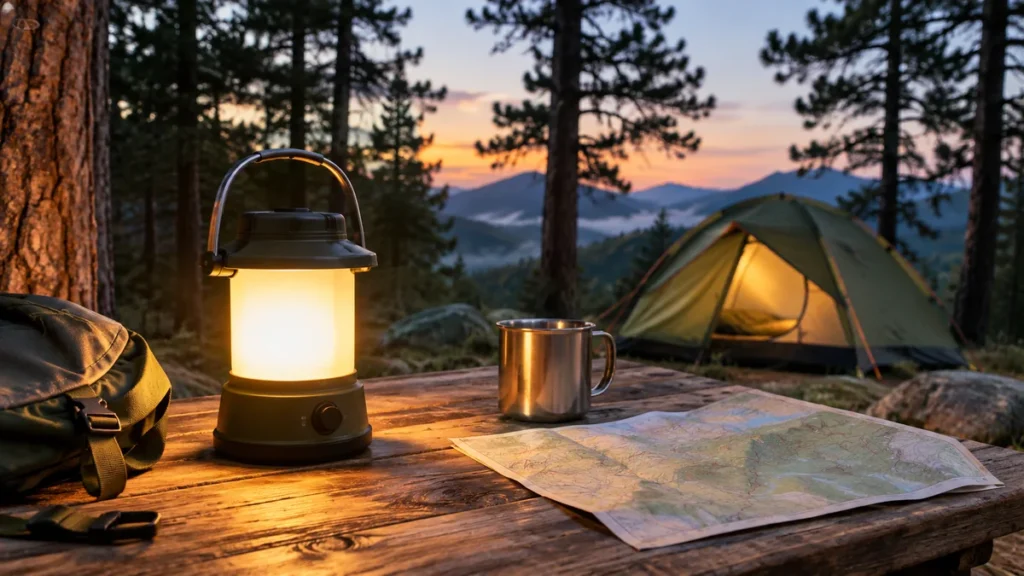
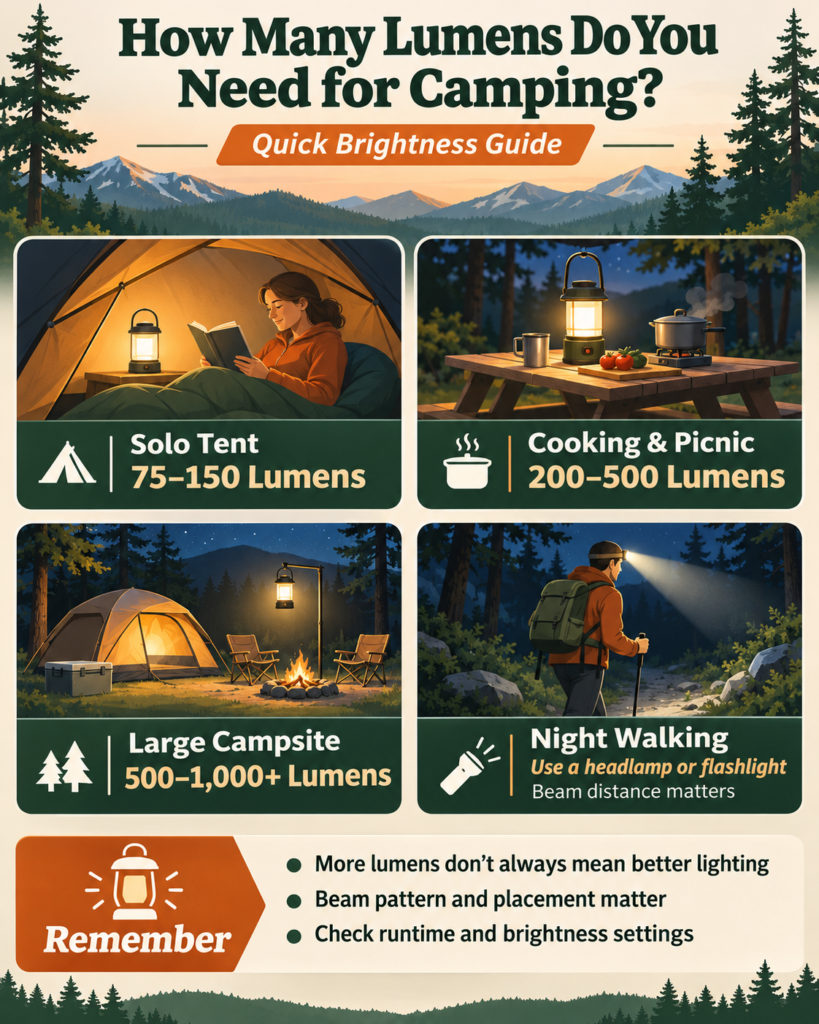
Wondering how many lumens you need for camping? For most camping trips, a lantern with around 200–500 lumens is a practical starting point for cooking, eating, and general campsite activities. Inside a small tent, 75–150 lumens is often enough. Larger campsites may benefit from 500–1,000 lumens or more, depending on the space and how the light is distributed.
But here’s something many first-time campers overlook: more lumens don’t always mean a better camping experience.
An extremely bright lantern can make a small tent uncomfortable, while a compact headlamp with a focused beam may help you see farther than a powerful lantern.
The best camping light is the one that delivers the right brightness, beam pattern, and battery life for the activities you actually do.
In this guide, we’ll break down how many lumens you need for different camping situations, explain what the numbers on lighting products really mean, and help you choose the right setup without paying for brightness you may never use.
How Many Lumens Do You Need for Camping? Quick Reference Chart
Before choosing a camping light, think about where you’ll use it and what you need to see.
Here’s a practical brightness guide for common camping activities.
| Camping Activity | Suggested Lumens | Recommended Light Type |
| Relaxing inside a small tent | 75–150 | Compact LED lantern |
| Reading or playing cards | 75–150 | Dimmable lantern or low-output headlamp |
| Cooking at a campsite | 200–500 | Adjustable camping lantern |
| Eating around a picnic table | 200–500 | Diffused LED lantern |
| Lighting a larger campsite | 500–1,000+ | Large lantern or multiple smaller lights |
| Walking around camp at night | Depends on beam distance and terrain | Headlamp or flashlight |
| Backpacking and minimalist camping | Prioritize low modes, runtime, and weight | Compact lantern or headlamp |
So, how many lumens do you need for camping? The right starting point depends on the area you want to light and whether you need broad or focused illumination.
What Are Lumens, and Why Do They Matter?
When browsing camping lights, you’ll often see specifications such as 100 lumens, 300 lumens, or 1,000 lumens.
But what exactly do those numbers tell you?
A lumen (lm) measures the total amount of visible light emitted by a source. Generally speaking, a light with more lumens produces more total light.
However, lumens alone don’t tell you how well a lantern will illuminate a particular area.
Lumens vs. Lux: What’s the Difference?
These two measurements are related, but they’re not interchangeable.
Lumens describe how much visible light a source produces.
Lux measures the amount of light reaching a surface per square meter.
Imagine two camping lights rated at 300 lumens.
The first is a lantern that spreads light around your picnic table. The second is a flashlight that concentrates much of its output into a narrow beam.
Although their total light output may be similar, they’ll feel very different in use.
The lantern is better suited to illuminating a shared space, while the flashlight may be more effective when you need to see a specific object farther away.
That’s why you should consider beam distribution and placement alongside the lumen rating.
For a technical explanation of these measurements, see Konica Minolta’s photometry guide.
How Many Lumens Do You Need for Different Camping Activities?
Your ideal brightness depends on how you camp.
A couple relaxing inside a two-person tent has very different lighting needs from a family preparing dinner at a large campsite.
Let’s look at the most common situations.
1. Inside a Small Camping Tent: 75–150 Lumens
You usually don’t need a powerful lantern inside a tent.
In fact, too much light can make a small enclosed space feel uncomfortable.
For reading, organizing your belongings, or getting ready for bed, a small LED lantern with a gentle, diffused glow is often sufficient.
A lantern in the 75–150 lumen range can be a useful starting point for these tasks.
BioLite recommends approximately 75–150 lumens for tent lighting, which is a helpful reference when choosing a compact light.
Look for a lantern with adjustable brightness, soft light diffusion, and a hanging hook or loop.
Hanging the light near the center of the tent may provide more even illumination than placing it on the floor.
If you’re sharing a tent, use a lower setting when someone else is trying to sleep.
Best fit: Compact, dimmable LED lanterns for small tents.
2. Cooking and Preparing Food: 200–500 Lumens
Cooking after sunset usually requires more illumination than relaxing inside a tent.
You need enough light to see ingredients, utensils, the cooking surface, and your work area.
A camping lantern with approximately 200–500 lumens is a reasonable starting point for many campsite cooking setups.
However, brightness isn’t the only consideration.
Light placement matters just as much.
A lantern placed directly behind you may cast shadows across the table. Positioning the light slightly above or to the side of your workspace can help make the area easier to see.
If you’re using a stove, keep your light and its battery away from excessive heat and follow the manufacturer’s placement and safety instructions.
For cooking, a lantern with a broad beam and adjustable brightness is generally more practical than a narrow flashlight.
Best fit: Dimmable camping lanterns with wide, even light distribution.
3. Eating and Socializing Around a Picnic Table: 200–500 Lumens
An evening meal outdoors doesn’t need to feel like sitting under a stadium floodlight.
A moderately bright lantern can help everyone see their food, play games, or enjoy conversations.
For a typical campsite picnic table, 200–500 lumens is a useful starting range.
If the light feels too harsh, lower its brightness or place it farther away.
Some campers prefer warm, diffused lighting for relaxing, while brighter neutral-white light may be more useful when handling food or equipment.
Best fit: LED lanterns with dimming and comfortable area lighting.
4. Lighting a Larger Family Campsite: 500–1,000+ Lumens
Larger campsites may need additional brightness, especially when several people are moving between tents, cooking stations, and seating areas.
But one extremely powerful lantern isn’t always the best answer.
Instead, consider creating several lighting zones.
For example, you could use one lantern near the cooking area, another near the seating area, and a smaller light inside the tent.
This distributes illumination more evenly and reduces the need to carry one oversized light.
For broader campsite lighting, approximately 500–1,000 lumens or more may be useful, depending on the size of the space.
You can also use multiple lower-output lights.
Best fit: Adjustable lanterns used individually or as part of a multi-light setup.
5. Walking Around Camp After Dark: 100–300 Lumens or More
Walking to the restroom, checking tent stakes, or finding something in your vehicle is different from lighting a campsite.
For these tasks, a headlamp or flashlight is often more useful than a lantern.
A focused light can direct illumination where you’re looking without flooding the entire campsite.
For short walks on familiar, relatively clear ground, a headlamp with adjustable output around 100–300 lumens may be practical.
For unfamiliar trails, uneven ground, or situations requiring greater visibility, you may need a stronger beam and longer beam distance.
A higher lumen rating does not automatically guarantee longer visibility. Beam design plays a major role.
For nighttime walking, prioritize a dependable headlamp with comfortable low and medium settings, suitable beam distance, and adequate battery life.
Best fit: Adjustable headlamps or handheld flashlights.
Is 100, 300, 500, or 1,000 Lumens Enough for Camping?
You may have already found a camping lantern with a particular lumen rating and wondered whether it’s powerful enough.
Here’s how to think about four common brightness levels.
Is 100 Lumens Enough for Camping?
Yes, for certain tasks.
A 100-lumen lantern can provide useful light inside a small tent, especially when you only need to read, organize gear, or relax.
However, it may not be sufficient as your only light source for a large campsite.
Is 300 Lumens Enough for Camping?
For many casual campers, 300 lumens is a useful middle ground.
A 300-lumen lantern may be adequate for lighting a small cooking station, picnic table, or compact campsite, depending on its beam distribution.
If you’re choosing your first rechargeable camping lantern, this is a reasonable brightness category to consider.
Is 500 Lumens Enough for Camping?
For most ordinary car-camping setups, a 500-lumen lantern offers considerable flexibility.
It may provide enough light for cooking, shared activities, or illuminating a moderate campsite area.
A dimmable model is particularly useful because you won’t need maximum brightness all evening.
Do You Need 1,000 Lumens for Camping?
Not necessarily.
A 1,000-lumen lantern can be helpful for illuminating larger spaces, but it’s often excessive inside a tent.
High brightness may also shorten battery runtime when compared with lower output modes.
Before choosing a 1,000-lumen model, ask yourself whether you need to light a large area or whether several smaller lights would work better.
Bottom line: Don’t choose a camping lantern solely because it has the highest lumen number.
Choose enough light for your actual activities, with the flexibility to turn it down.
Camping Lantern vs. Headlamp vs. Flashlight: Which Should You Choose?
Different camping lights are designed for different jobs.
Understanding these differences can help you avoid buying equipment that doesn’t suit the way you camp.
| Feature | Camping Lantern | Headlamp | Flashlight |
| Main purpose | Lighting a shared area | Hands-free personal lighting | Directional illumination |
| Light distribution | Usually broad and diffused | Focused, wide, or adjustable | Often directional |
| Best for | Tents, cooking, picnics | Walking, setup, camp chores | Checking distant objects |
| Hands-free use | Yes, when positioned or hung | Yes | Usually no |
| Main consideration | Beam spread and dimming | Comfort and beam pattern | Beam distance and controls |
When a Camping Lantern Makes Sense
Choose a lantern when several people need to share the same light.
Lanterns are ideal for tent interiors, picnic tables, and general campsite illumination.
When a Headlamp Is Better
Choose a headlamp when you need both hands.
It’s particularly useful when pitching a tent after sunset, handling camping equipment, or walking around the campsite.
A headlamp is also a practical backup if your main lantern runs out of power.
When a Flashlight Is Useful
Choose a flashlight when you need directional light for a particular task or want to inspect something farther away.
For a typical weekend camping trip, you may find that one lantern for shared lighting and one headlamp per person provides a more flexible setup than relying on a single powerful light.
Why Maximum Lumens Don’t Tell the Whole Story
When comparing camping lights, maximum brightness is only one part of the decision.
These additional features can make a major difference in everyday use.
1. Battery Runtime
A lantern’s maximum lumen output and advertised maximum runtime usually describe different operating conditions.
A light may provide high output for a relatively short period and much longer battery life at a lower setting.
Always check whether the manufacturer specifies runtime for each brightness mode.
Don’t assume a lantern can maintain its highest output for the full advertised maximum runtime.
2. Adjustable Brightness
A dimmable lantern is useful because camping activities change throughout the evening.
You might want more light while preparing food, then much less when relaxing inside your tent.
A good low-brightness mode can be just as valuable as a high maximum output.
3. Beam Pattern and Light Diffusion
The way light spreads can affect how comfortable it feels.
A broad, diffused lantern is useful for shared spaces.
A focused beam works better when you need to see a particular area.
If possible, look for photographs or reliable demonstrations showing the light in actual use, rather than relying only on a specification table.
4. Power Source and Charging Options
Rechargeable lanterns are convenient for weekend car camping, especially when you have access to a vehicle charger or power bank.
Replaceable-battery models can be useful when charging facilities are limited, provided you carry compatible spare batteries.
For multiday trips, think about how you’ll recharge or replace the power source before choosing a light.
5. Weather Resistance and Durability
Camping lights may be exposed to rain, dust, condensation, or accidental drops.
Check the manufacturer’s stated water-resistance rating and operating instructions.
Water-resistant does not necessarily mean waterproof, and a rating for splashes should not be interpreted as permission to submerge the device.
6. Weight and Portability
If you’re car camping, a slightly larger lantern may be perfectly reasonable.
Backpackers, on the other hand, often need to consider every ounce of pack weight.
Choose a light that fits your travel style rather than carrying unnecessary bulk for extra brightness.
What Is ANSI/PLATO FL 1, and Why Does It Matter?
You may notice that some flashlights and headlamps display standardized performance information.
One widely used portable-lighting standard is ANSI/PLATO FL 1.
It provides standardized methods for testing and reporting several aspects of portable lighting performance, helping buyers compare equipment more consistently.
Depending on the device and applicable claims, these measurements can include light output, beam distance, runtime, and durability-related performance.
Understanding Light Output and Runtime
For ordinary operating modes under the ANSI/PLATO FL 1-2025 standard, light-output measurements are taken between 30 seconds and two minutes after activation.
The standard runtime method starts from the measured output at 30 seconds and ends when the light falls to 10% of that reference output.
This is important because a product’s reported runtime does not necessarily mean it remains at maximum brightness throughout that period.
A light can gradually become dimmer and still be operating within its reported runtime.
What Changed in the 2025 Standard?
The ANSI/PLATO FL 1-2025 revision introduced a dedicated method for short-duration elevated-brightness modes, often marketed as Turbo or Boost.
For these modes, light output is measured during the first one to ten seconds after activation.
The short-duration runtime measurement uses a different endpoint: when output drops to 90% of the maximum value measured during that initial interval.
This helps distinguish a brief brightness burst from a normal operating mode.
The updated standard also addresses additional dust-protection and water-resistance testing procedures.
For buyers, the practical lesson is simple:
A very high advertised lumen number may describe a temporary mode rather than the brightness you’ll use throughout an evening.
When comparing lights, look for output information, runtime at useful settings, and the testing method behind the claims.
For technical details, see the Portable Lights American Trade Organization’s explanation of ANSI/PLATO FL 1-2025.
How to Choose the Right Camping Light for Your Trip
Rather than starting with a maximum lumen rating, begin with how you plan to use your lighting.
For Solo Backpacking
Look for a compact, lightweight light with reliable low-output settings.
A small lantern may be sufficient for tent use, while a headlamp can handle walking and hands-free tasks.
Battery life and carrying weight may matter more than extreme brightness.
For Weekend Car Camping
A rechargeable lantern with adjustable brightness and moderate-to-high output is a flexible choice.
A model capable of roughly 300–500 lumens, or somewhat more, may be suitable for many common campsite activities.
Pair it with a headlamp for walking or individual tasks.
For Family Camping
Consider lighting the campsite in zones.
One lantern near the picnic table, another near a shared seating area, and smaller lights inside the tents may provide a more comfortable setup.
Multiple lights also give family members more flexibility.
For Longer Trips Without Reliable Charging
Prioritize realistic runtime and a dependable power plan.
Check charging requirements, battery compatibility, and low-output endurance.
A higher maximum lumen rating offers little benefit if the light runs out of usable power when you need it.
Common Camping Light Buying Mistakes
Buying the Brightest Light Available
A higher maximum lumen count isn’t always worth the extra size, weight, or cost.
If you mostly read inside a tent or relax around a small table, a moderately bright lantern with excellent dimming may be the better choice.
Ignoring Low-Brightness Settings
A lantern that produces hundreds of lumens but lacks a comfortable low setting may be unpleasant inside a small tent.
Check how much control you have over the light output.
Overlooking Actual Battery Runtime
Always compare how long the light operates at the brightness you’ll actually use.
A maximum-runtime figure shown without its corresponding mode can be misleading.
Choosing One Light for Every Task
A lantern can illuminate shared spaces, but it may be inconvenient when you’re walking, climbing into a tent, or setting up equipment.
A small headlamp can make your lighting setup more practical.
Forgetting About Light Placement
Even a powerful lantern can leave your cooking area in shadow if it’s positioned poorly.
Think about where you’ll hang or place the light, as well as how the beam spreads.
Frequently Asked Questions
How many lumens do you need for a camping lantern?
For many everyday campsite activities, a lantern capable of approximately 200–500 lumens is a practical starting point. Smaller tents may need less, while large campsites may benefit from brighter or multiple lights.
Is 100 lumens bright enough for a tent?
Yes. A 100-lumen lantern can provide useful illumination in a small tent, particularly for reading, organizing gear, or relaxing. A dimmable light can make the experience more comfortable.
Is 300 lumens enough for camping?
For many casual camping activities, yes. A 300-lumen lantern may work well around a small picnic table, compact cooking station, or tent. Actual performance depends on beam distribution and placement.
Are 500 lumens enough for a campsite?
A 500-lumen lantern can be a versatile choice for many ordinary campsites. For very large areas, consider adding another light rather than relying on a single lantern.
Is 1,000 lumens too bright for a camping tent?
A 1,000-lumen output is generally more than you need inside a small tent. However, a lantern with a 1,000-lumen maximum may still work well if it has a sufficiently low dimming mode.
How many lumens do I need for night hiking?
There is no single lumen requirement for every trail. Beam distance, terrain, walking speed, and conditions all matter. A headlamp with adjustable brightness and an appropriate beam pattern is important; more demanding navigation may require substantially greater output than routine campsite walking.
Do more lumens mean better battery life?
No. For the same light, operating at a higher output typically uses energy faster. Compare manufacturer runtime specifications for the brightness modes you expect to use most often.
Should I buy a camping lantern or a headlamp?
If you mainly need to illuminate a shared tent or campsite, start with a lantern. If you need hands-free light while walking or working, a headlamp is more practical. Many campers benefit from having both.
Final Recommendation: How Many Lumens Are Best for Camping?
For most campers, the best lighting setup isn’t necessarily the brightest one.
It’s the one that provides enough illumination for your activities while remaining comfortable, portable, and dependable.
As a simple starting point:
- 75–150 lumens: Small tents and close-range lighting.
- 200–500 lumens: Cooking, eating, and general campsite activities.
- 500–1,000+ lumens: Larger campsite areas or group lighting.
- An adjustable headlamp: Useful for walking and hands-free tasks.
These are practical estimates, not fixed rules. Always consider the beam pattern, runtime, and lighting conditions.
If you’re preparing for your first camping trip, a dimmable lantern with moderate brightness and a reliable headlamp is a sensible combination.
You don’t need to turn your campsite into a stadium. You just need enough light to enjoy the outdoors safely and comfortably.
If you’re still wondering how many lumens you need for camping, start with your main activities and choose a light with adjustable brightness.
Editorial Sources
The following resources were consulted to develop this guide:
- BioLite — How Many Lumens Do I Need? Lanterns Edition
- REI — Camping & Emergency Lanterns: How to Choose
- REI — How to Choose an LED Headlamp
- PLATO — ANSI/PLATO FL 1-2025: Getting the Testing Right
- Konica Minolta — Photometry and Lighting Measurements
Editorial note: Brighture Life has not independently tested the lighting products described in this guide. Brightness recommendations are based on published technical information and general camping use cases, not original laboratory measurements.